Inside the Oikos
A morning in an Athenian household
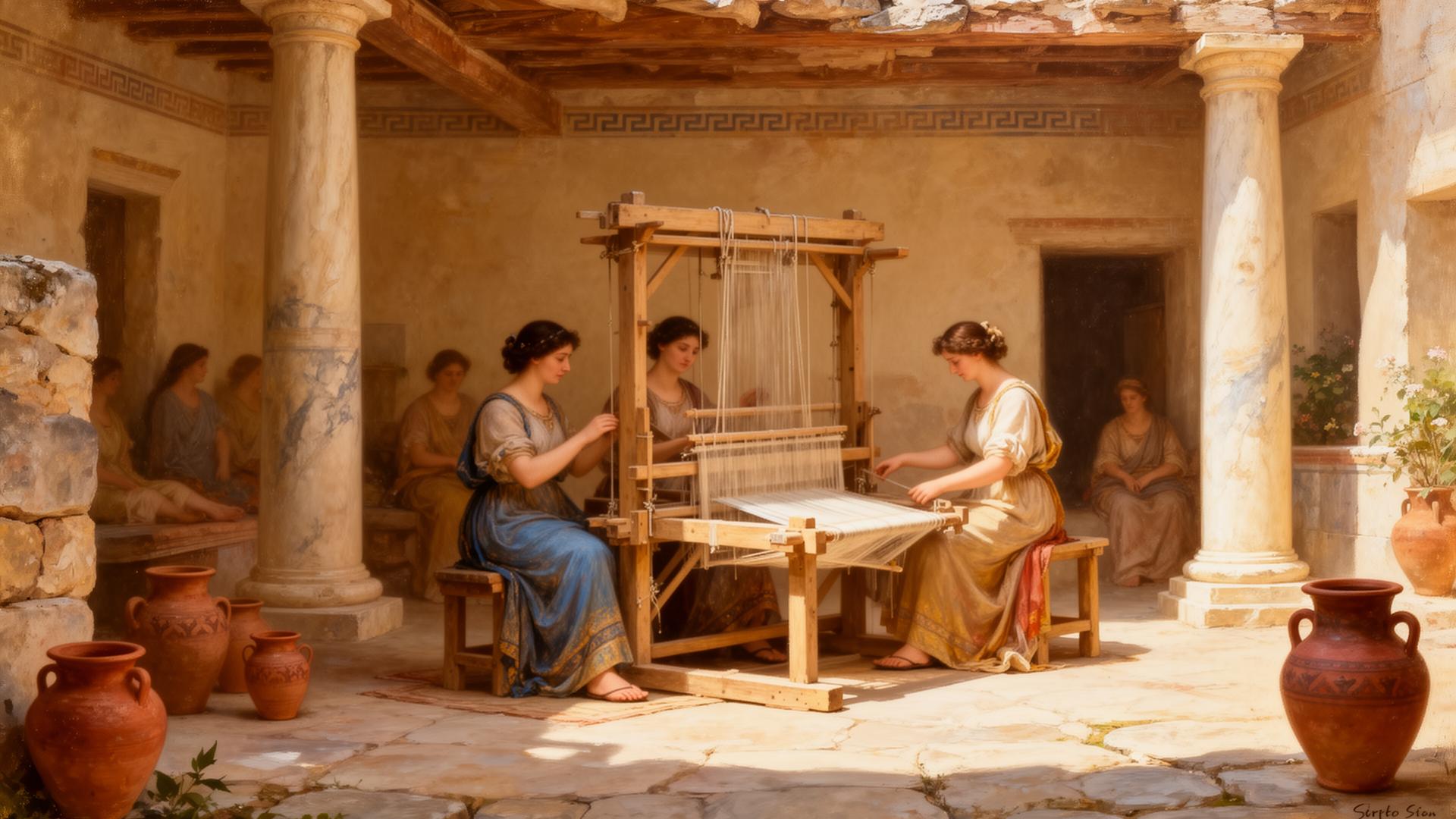
I was admitted to the home of a wool merchant in the deme of Melite shortly after dawn, and the first thing I noticed was the sound: not the clatter of the agora outside, but the steady percussion of loom weights swinging against warp threads. Beyond a small columned courtyard, three women worked at a tall vertical loom while a fourth ground barley at a stone quern. This was the oikos, at once house, household, and economic unit, and within it the lady of the home, whom I shall call Myrrhine, ruled a kingdom whose borders ended at her threshold.
Xenophon, in his Oeconomicus, had laid out the philosophy that organized Myrrhine's day. The husband must train his wife as a partner in management, "for the gods have made the woman's nature for indoor work and the man's for outdoor." Every detail of the house confirmed how completely a wife's world was defined by walls. The street door was bolted; the single high window admitted light but no view. Myrrhine had not, she told me, crossed the threshold in eleven days.
"Her duty is to remain indoors and to send out those of the household whose work is outside.", Xenophon, Oeconomicus
Yet what happened inside those walls was hardly idleness. Sue Blundell has argued that the Athenian wife's labor, supervising slaves, preserving grain, weaving the family's clothes, raising the children, managing the storerooms, was the actual productive engine of the household economy, even if the law gave her no standing to own its property. I watched Myrrhine inventory a pithos of olive oil, scold a slave for a cracked amphora, and dispatch another to the public fountain. By midmorning she had made decisions that would have bankrupted a careless steward.
The loom was the throne. Sarah Pomeroy reminds us that textile production was identity: funerary inscriptions praise the virtuous wife as a weaver. The peplos Myrrhine was finishing, saffron warp, deep-sea purple weft, would clothe her daughter at the Panathenaia. Aristotle, in On a Good Wife, held that a woman's excellence lay in modesty, silence, and the perfect ordering of what was hers to order. Watching Myrrhine direct her looms with a tilt of the chin, I understood his prescription as a description of power he could not quite name.
I left at the noon meal, which Myrrhine did not share; her husband would dine in the andron with male guests while she ate with the children behind a curtain. Lin Foxhall warns us not to read this as simple oppression, the seclusion of elite women was, paradoxically, a marker of wealth, and poorer women moved freely through streets and markets. But the architecture of the oikos made plain what the philosophers only theorized: in Classical Athens, the wall between inside and outside was the wall between woman and city. The cultural achievement I had come to see was not a monument. It was a system of organized invisibility, and the women who made it run.