Athena Parthenos
Within the Parthenon at noon
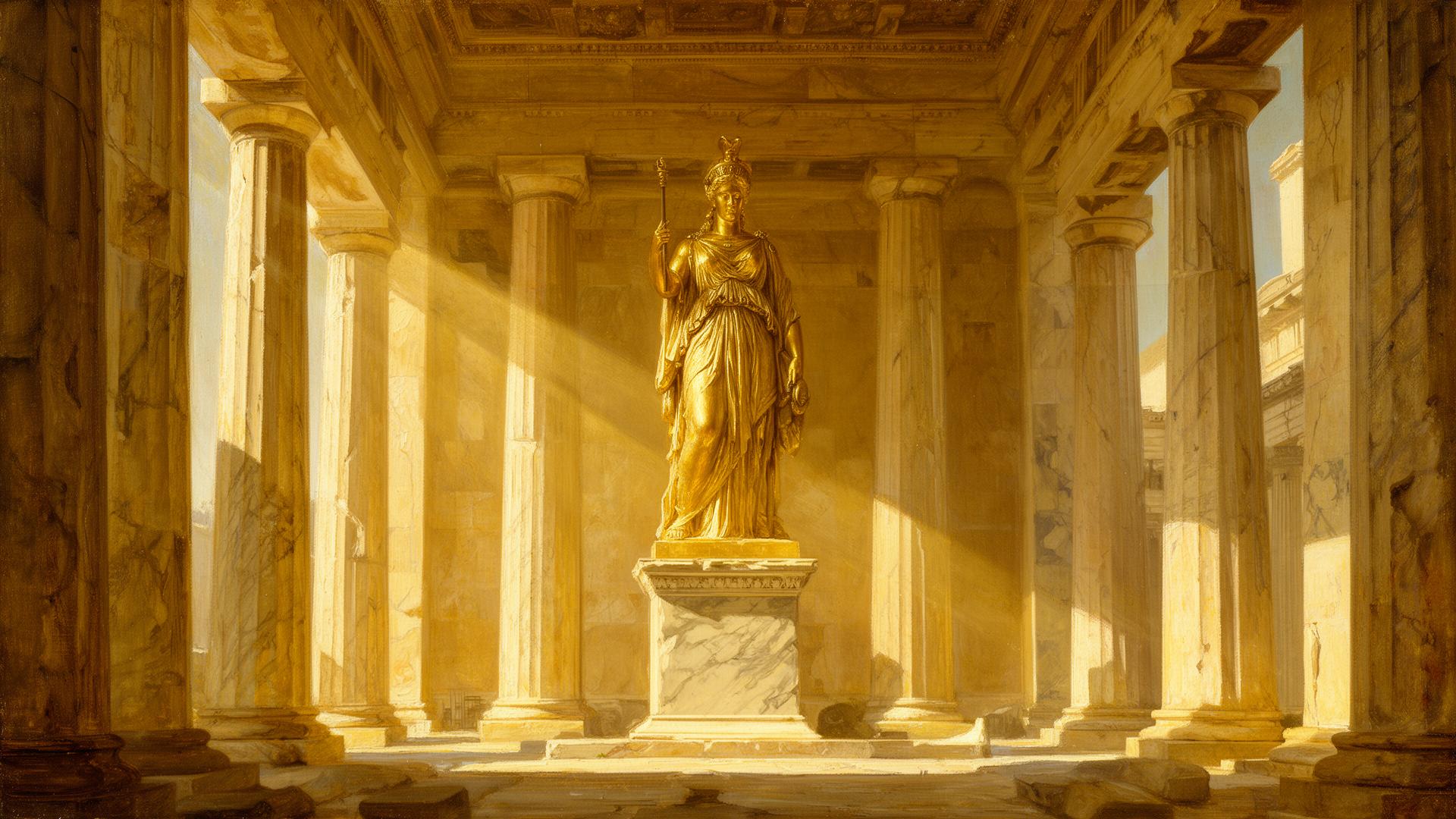
I climbed the Acropolis on the morning of the Panathenaia, when the sacred way was thick with sacrificial cattle, garlanded girls, and small boys carrying libations. The Parthenon, completed in 432 BCE, only a decade before my visit, rose at the summit in the hard noon light, its Pentelic marble still so new it glowed pink at the edges. To step inside is to encounter something stranger and more contradictory than the postcards admit.
The cella was darker than I expected. Once my eyes adjusted, I saw her: Athena Parthenos, the Virgin Athena, nearly forty feet tall, her flesh of carved ivory and her armor and robe of beaten gold over a wooden core. Phidias had given her a small Nike in her right hand and a shield at her left, the serpent Erichthonius coiled within. Light from the eastern door struck the gold and the whole interior breathed with reflected fire. I understood why visitors from the Persian court were said to fall silent, and why Pericles had spent the tribute of an empire to build her house.
"The city's true citadel is its goddess, and her body is built of what the city can give.", overheard outside the cella
What is harder to understand is what it meant for a city that confined its mortal women to the inner room to worship a virgin goddess of war and wisdom as its supreme civic protector. Sarah Pomeroy traces the paradox sharply: the Greek pantheon was crowded with powerful females, and yet living Athenian women could not vote, own significant property, plead in court, or walk the agora unveiled. Mary Lefkowitz and Maureen Fant collect the inscriptions showing how women participated in Athena's cult anyway, as the arrephoroi, four noble girls who slept on the Acropolis and helped weave the great peplos; as the priestess of Athena Polias, one of the most prestigious offices in the city, always held by a woman.
I climbed afterward to the Erechtheion, where the Caryatids, six maidens of marble, bear the porch with the easy patience of women who have been holding things up for a very long time. Elaine Fantham observes that these stone women were not portraits but idealizations: the Athenian polis literally rested on the figure of the obedient maiden. Yet the priestess inside was a real woman, and the peplos folded into Athena's lap each Panathenaia had been woven by real women's hands over a year. The great cultural achievement of the Acropolis was not only its marble or its gold. It was the way the city embedded the labor of its women into its most sacred stones, indispensable, and almost never named.
I left as the sun fell toward Salamis. Below, the city stretched under its veil of dust, and somewhere in it Myrrhine was finishing the saffron peplos for her daughter's Panathenaic procession. Up on the rock, the goddess looked down on them both.