A Wedding Procession
From hearth to hearth at dusk
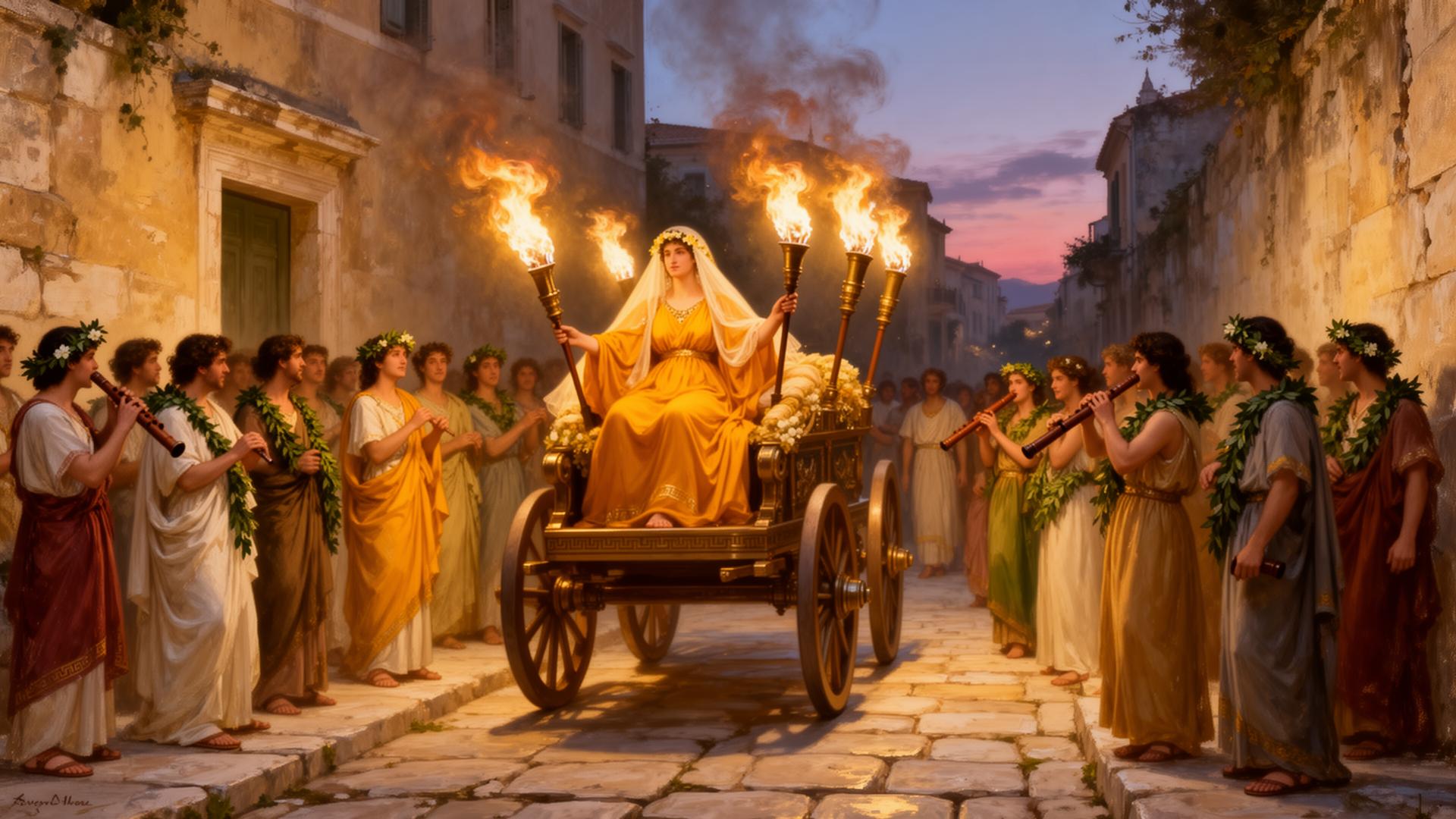
The month of Gamelion is named for marriage, and on the eighth evening I was invited to witness the wedding of a fifteen-year-old girl named Kleo to a man of twenty-nine she had met three days earlier. The Athenian wedding was not an exchange of vows between two people who had chosen each other. It was a ritualized transfer of a woman from one household to another, and the city had perfected its choreography over centuries.
The day began with the proteleia, in which the bride dedicated her childhood toys and a lock of her hair to Artemis. She was bathed in water carried in a loutrophoros from the spring of Kallirrhoe. Sue Blundell describes this bath as the symbolic threshold of the rite: the girl who emerged was no longer a parthenos but a nymphē, on her way to becoming a gynē. Her relatives dressed her in a long chiton, crowned her with myrtle, and drew the saffron veil across her face.
"Lead her gently. She crosses tonight from her father's hearth to mine, and the gods are watching the door.", the groom to the torchbearers
At dusk the feast began in the andron. Men reclined; women sat. The bride ate a quince, a fertility offering. Plutarch, drawing on older custom in his Advice to the Bride and Groom, urged grooms to treat young wives gently, "for she is most easily fashioned at the beginning, like a wax tablet." His advice betrays an anxiety I came to recognize: the Athenians knew that marrying a near-stranger to a girl half his age was a fragile foundation, and they hoped ritual could supply what affection might not.
The procession, the pompē, began after dark. Kleo, still veiled, was lifted into a mule cart between her husband and his best friend; her mother walked behind carrying a torch lit at her own hearth, a flame that would kindle the new household's fire. Pipers played the aulos; children threw nuts and figs; neighbors called the ritual cries of Hymen, Hymenaios! Lin Foxhall observes that the neighborhood functioned as a witness: the marriage was not a private contract but a public alteration of the city's map of households. At the groom's door, his mother met them with a torch of her own, and Kleo was carried over the threshold so her foot would not stumble.
Inside, she was led to the hearth and given a basket of dates and a piece of wedding-cake. She unveiled. Sarah Pomeroy notes that this anakalypteria was the legal heart of the rite: the gifts the husband gave at this moment established the bride's standing in his house. Then the door closed, and Kleo was, by every law of Athens, a wife. She was, by my reckoning, still a child. The cultural achievement I had come to witness was the choreography itself, exquisite, ancient, and merciless, by which the city converted its daughters into the next generation of mothers, weavers, and managers of the oikos.