The Theatre of Dionysus
The premiere of Medea, 431 BCE
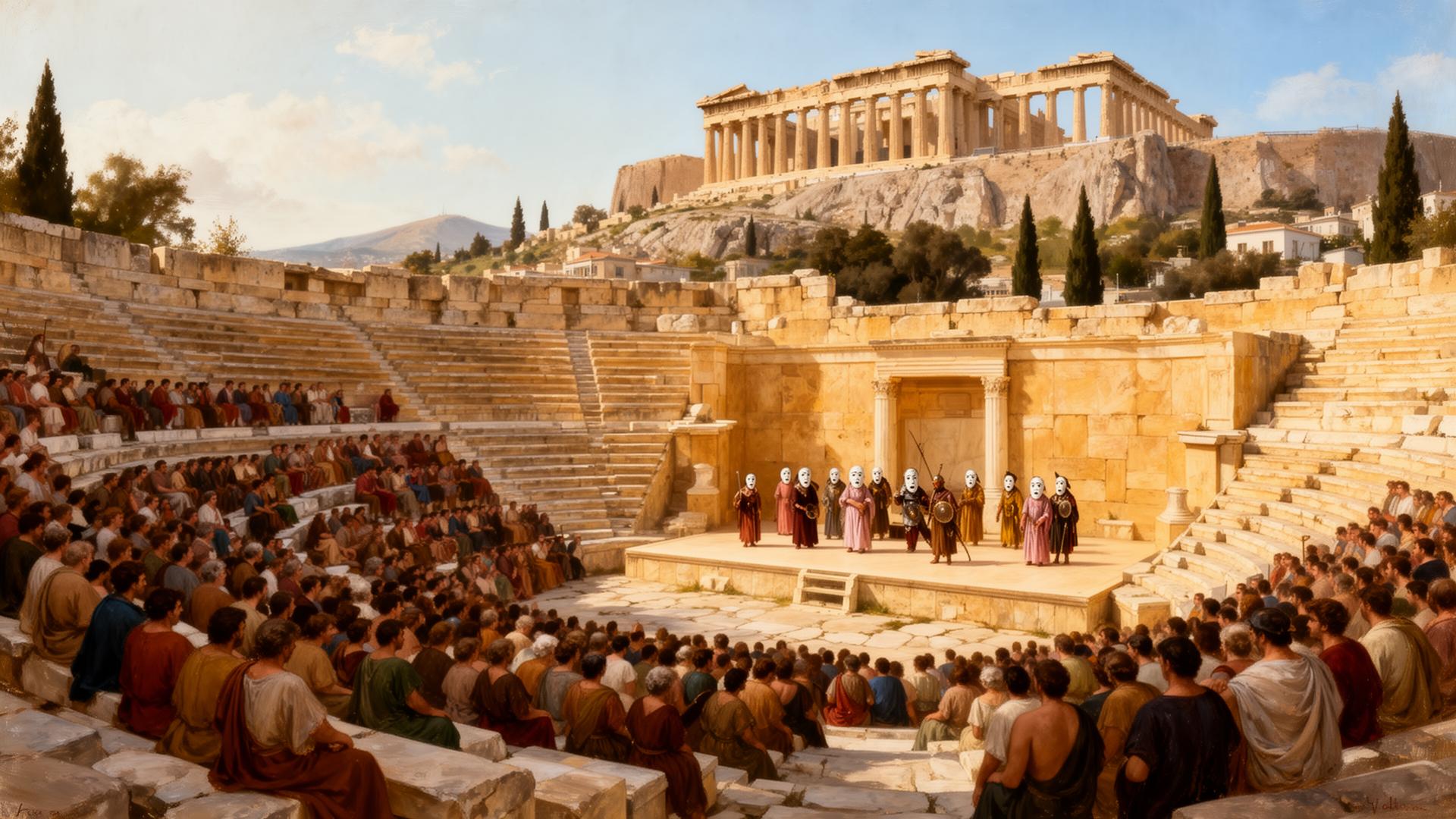
I had timed my visit for the spring of 431 BCE, the City Dionysia of the year war broke out with Sparta, because I wanted to be in the audience when Euripides staged his Medea. The play would lose the festival prize, taking only third place, yet it would become one of the most disturbing plays in the Western canon. Sitting on a sun-warmed bench on the south slope of the Acropolis with fourteen thousand citizens around me, I watched the city look at itself in a mirror it had not asked for.
The festival was a civic spectacle on the scale of the Panathenaia: five days of tragedies and comedies funded by the wealthiest citizens as public duty. The audience was overwhelmingly male, though Lin Foxhall and Elaine Fantham continue to debate whether respectable women attended. What is certain is that the women on stage were played by men, masked and robed; that all playwrights and judges were men; and that the stories told under the open sky were saturated with female voices, female crimes, and female grief.
"Of all things which are living and can form a judgment, we women are the most unfortunate creatures.", Medea, lines 230–231
Then Medea entered: a sorceress from Colchis, betrayed by the husband she had crossed the world for. Euripides gave her the most famous speech ever written about the lot of Greek women, the dowry that purchased a master, the marriage bed she could not refuse, the impossibility of divorce. Sarah Pomeroy argues this monologue did more to transmit the conditions of Athenian women's lives than any treatise, because Euripides put the words in the mouth of an outsider who could say what citizen wives could not. Lefkowitz and Fant include it in their sourcebook for exactly this reason.
Then Medea murdered her own children to punish their father. The audience made a sound I will never forget, not a gasp, but a long, low hum of dread. Hesiod's Works and Days had warned that women were a "beautiful evil," a Pandora unleashed by Zeus. Aristotle, in On a Good Wife, would later argue that female nature required masculine governance because, ungoverned, it was capable of monstrous things. Medea stages the nightmare those texts whisper: a clever woman, denied every legitimate channel, choosing the most ruinous available revenge.
Sue Blundell cautions against reading the play as protest literature, Euripides was not a feminist, and Medea's escape by dragon-chariot is hardly liberation. But Elaine Fantham is right that the play's existence matters as much as its meaning. The same city that locked its wives indoors paid for a stage on which a woman was permitted to say her life was unbearable. I thought of Myrrhine at her loom, of the women at the Thesmophoria, of Athena in gold and ivory, of Kleo behind her veil. The cultural achievement of Athenian theatre was that, for one afternoon, a city built on women's silence could bear to listen to one of them speak.