The Thesmophoria
Three nights with the women of Demeter
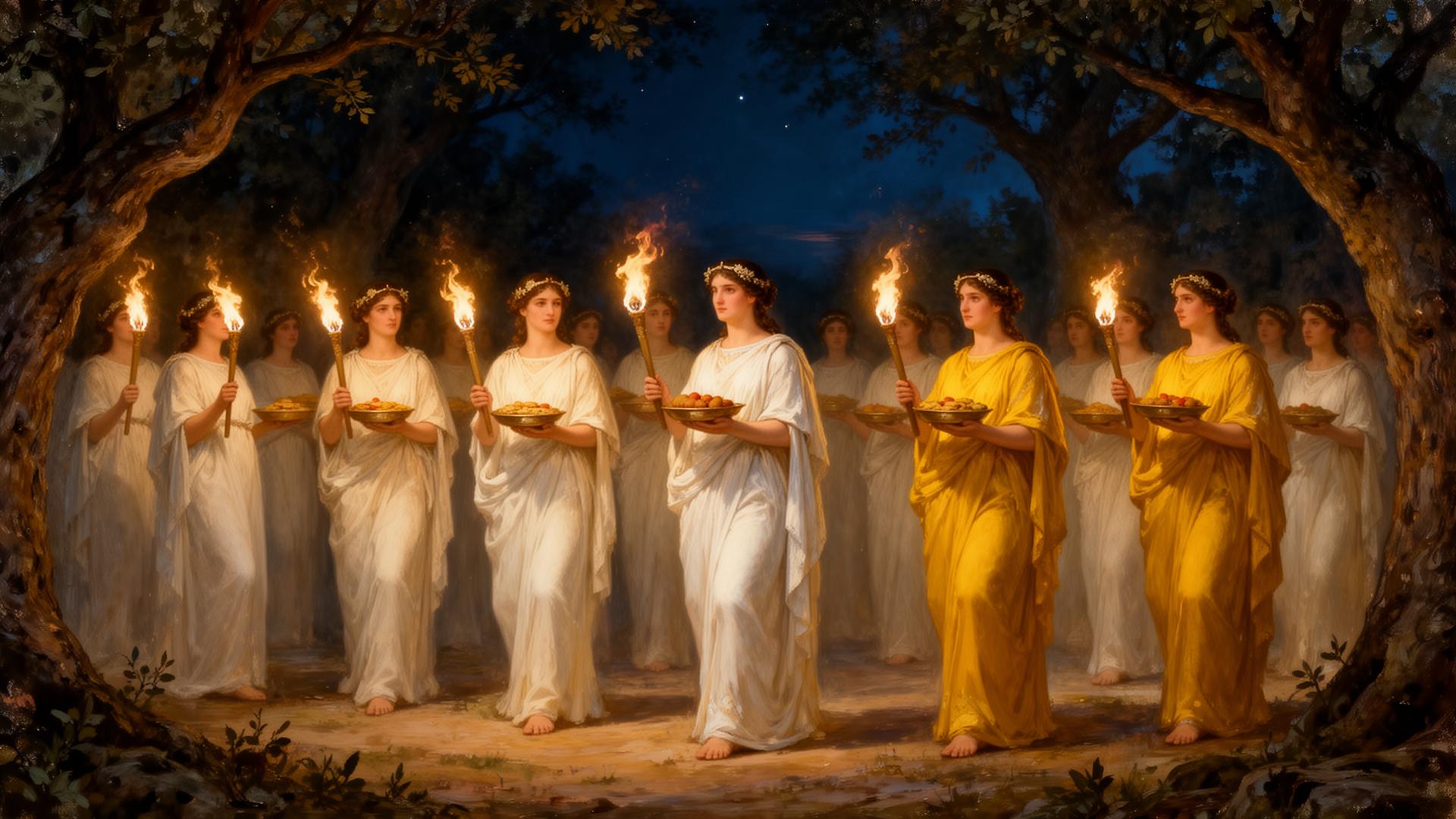
Of all the sights I came to see, the Thesmophoria was the one I least expected to glimpse. The festival was forbidden to men on pain of death, and I crouched among the cypresses on a hill above the Thesmophorion only because my hostess had taken pity on a foreigner. From there, for three nights, I watched a city I thought I knew dissolve into something older than the polis itself.
The Thesmophoria honored Demeter Thesmophoros, the lawgiver, and her daughter Persephone, whose descent and return marked the agricultural cycle on which Athens depended. Only married citizen women could attend. They camped for three days on sacred ground, slept on rough beds of lygos branches said to suppress desire, and on the second day fasted in mourning for Demeter's lost child. On the third, the Kalligeneia, "fair birth", they feasted, sang obscene songs, and called upon the goddess for the fertility of fields and wombs. For seventy-two hours the city's order was inverted: the Assembly did not meet, courts adjourned, and husbands cooked their own dinners.
"She first gave us laws.", invocation to Demeter Thesmophoros
What struck me most was the noise. Sue Blundell writes that the Thesmophoria was one of the few public occasions on which Athenian women could speak, and shout, and joke, and curse, without male censure, and the hill rang with a kind of laughter I had never heard inside an oikos. There were the cries of the antletriai, who descended into underground megara to retrieve the rotted remains of piglets sacrificed months earlier, mixed with seed corn for autumn fields. Sarah Pomeroy argues that festivals like this were not safety valves the patriarchy permitted but genuine ritual responsibilities the city could not perform without women, Athens could not eat in spring unless its wives buried piglets in autumn.
The implications were not lost on the Athenians. Aristophanes set an entire comedy at this festival, imagining the women plotting revenge against Euripides for slandering their sex on the tragic stage. The joke worked because everyone knew that for three days the women held something the men did not. Lin Foxhall's reading of the archaeological evidence shows that Thesmophoria sanctuaries existed in nearly every Greek polis, often on prominent civic ground, a load-bearing pillar of public religion.
On the third night I crept to the edge of the precinct as the women emerged, walking back into the city by torchlight, garlands askew, voices hoarse. At the first crossroads they fell silent and pulled their veils back up. The boundary snapped shut behind them. By morning Myrrhine would be once again an indoor creature. But she had buried the seed. The fields would rise. Whatever the philosophers said about a woman's nature, the city had just spent three nights admitting that it could not feed itself without her.